
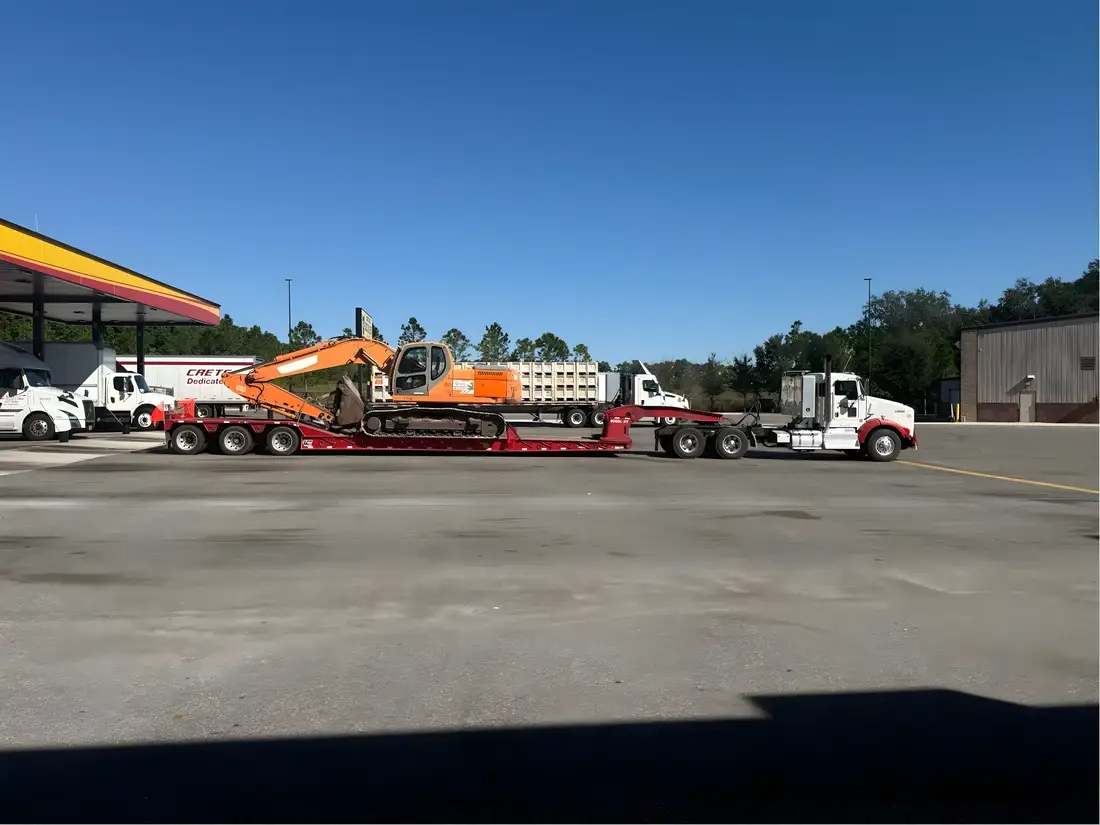
Customers often call asking for a lowboy when the machine really needs an RGN, or the other way around. Both trailers sit low to the road, and both ride behind our Kenworth tractor. The difference shows up when the machine gets on and off.
This post explains how each trailer works so you can describe your machine in a way that lets dispatch pick the right one.
What a lowboy trailer is built to do
A lowboy has a deck that sits close to the ground between the tractor and the rear wheels. That low deck gives a tall machine more clearance under bridges and wires than a flat deck would.
Lowboys suit a lot of everyday jobs: excavators, dozers, loaders, and other tracked or wheeled machines that need to ride low. Our lowboy transport page covers the kinds of machines we put on one.
The deck is the part that does the work. Ramps or a crane at the yard handle loading, and we plan that with you before the truck leaves Frostproof.
Because a lowboy rides low, the load height is easier to keep down. That helps on routes with overpasses and on jobs where the machine is tall to begin with.
How a removable gooseneck changes loading
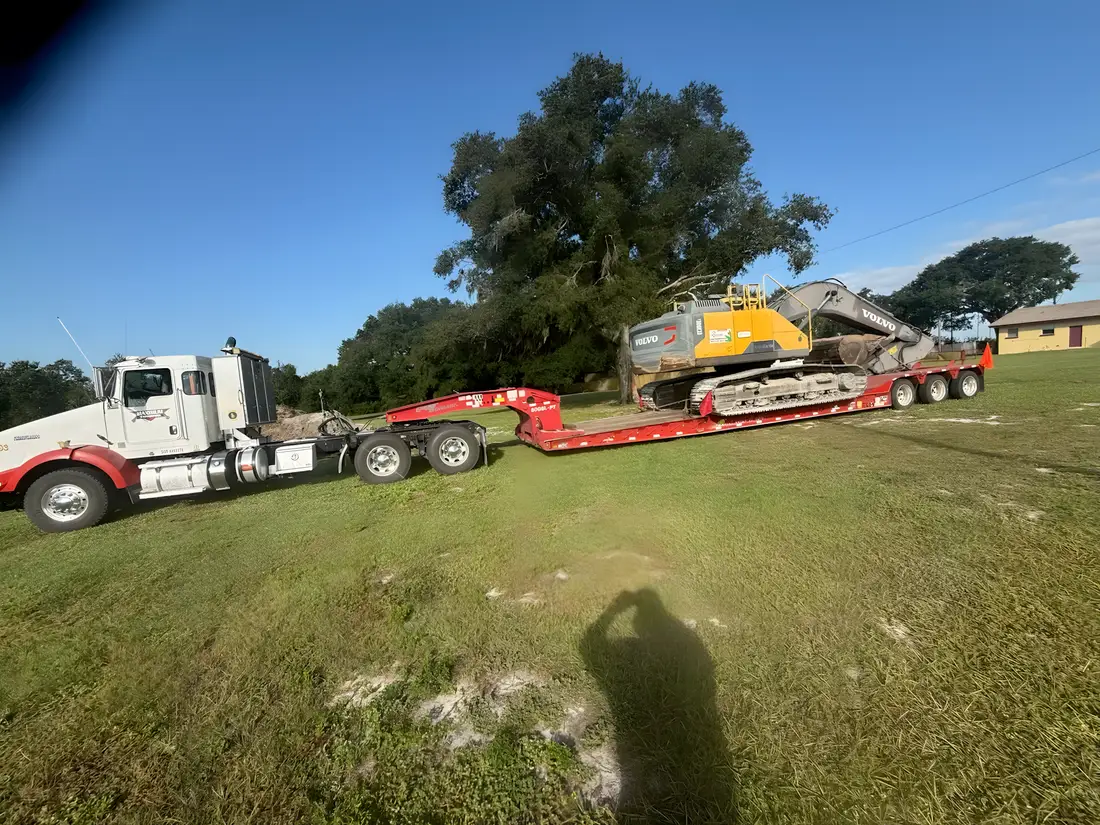
RGN stands for removable gooseneck. The front of the trailer detaches from the tractor and lowers its neck to the ground. The deck then forms a short slope the machine can drive up.
That matters when a machine cannot be lifted and a loading dock is not nearby. It also helps on soft ground and open lots where a long ramp would be awkward.
The trade is a few extra steps at each end. The driver disconnects the neck, loads the machine, and reconnects it. We plan that time into the schedule.
Our drivers handle the disconnect and the securing. Your crew only needs to have the machine ready, the ground clear, and someone at the site who can point the truck to the loading spot.
Height, width, and the permit line
The trailer changes the height of the load, and height decides a lot about the route. Florida needs a permit over 8 feet 6 inches wide, 13 feet 6 inches tall, or 80,000 pounds. We check the current FDOT permit rules for the route before we book the date.
A low deck helps keep a tall machine under the height line. It does not change the width. A wide blade, a thumb, or tracks that stick out can still put the load over the limit.
Our oversized load transport page explains what we do when a load needs a permit or an escort.
Matching the machine to the trailer
Here is how we think it through on the phone:
- A tracked machine that can drive on its own is a good fit for an RGN
- A machine that is lifted onto the deck by a crane or a dock works well on a lowboy
- A very tall machine needs the lowest deck we can use
- A machine that is heavy for its size needs the weight checked against what the trailer and the route allow
These are starting points, not rules. A machine with an odd attachment or a tight loading spot can change the answer, which is why we ask for photos.
Soft ground, tight yards, and loading spots
The trailer is only half of the plan. The other half is the spot where the machine gets on. A hard, level pad is easy. Sand, mud, or a slope is not.
Central Florida has a lot of sandy ground, and a loaded trailer can sink into it. If the machine sits in a field or behind a house, tell us. We may ask for a firmer spot nearby or for a second look at the route in.
Check the overhead space too. Low branches and wires are easy to miss from the ground, and they can stop a tall load before it leaves the lot. A photo of the loading area helps dispatch see what the driver will see.
What to send dispatch so we can choose
You do not need to know the trailer name. Send these items and we handle the rest:
- Make and model of the machine
- Width, height, and weight as it will travel
- Which attachments stay on
- Pickup and drop addresses
- A photo of the machine and a note on the ground at each end
The full checklist is in our post on how to prepare heavy equipment for transport. Dispatch answers 24 hours at 863-632-7302, or you can request a quote online.
Common questions about this
Is a lowboy the same thing as an RGN?
No. Both are low-deck trailers, but the RGN has a removable gooseneck that lets the front of the deck drop to the ground for loading.
Which trailer carries more weight?
We haul up to 82,000 pounds on either trailer. If a piece is heavier, we tell you on the first call.
Do I have to say which trailer I want when I call?
No. Give us the machine and the two addresses, and dispatch picks the trailer.
Related reading
Permits
Florida Oversize Load Permits: What to Know Before You Book a Haul
What makes a load oversize in Florida, when escorts come in, and what to tell the hauler before booking. We check the route rules.
Prep Guide
How to Prepare Heavy Equipment for Transport
A short checklist for getting heavy equipment ready for a lowboy or RGN haul in Florida: measurements, attachments, site access, and permits.